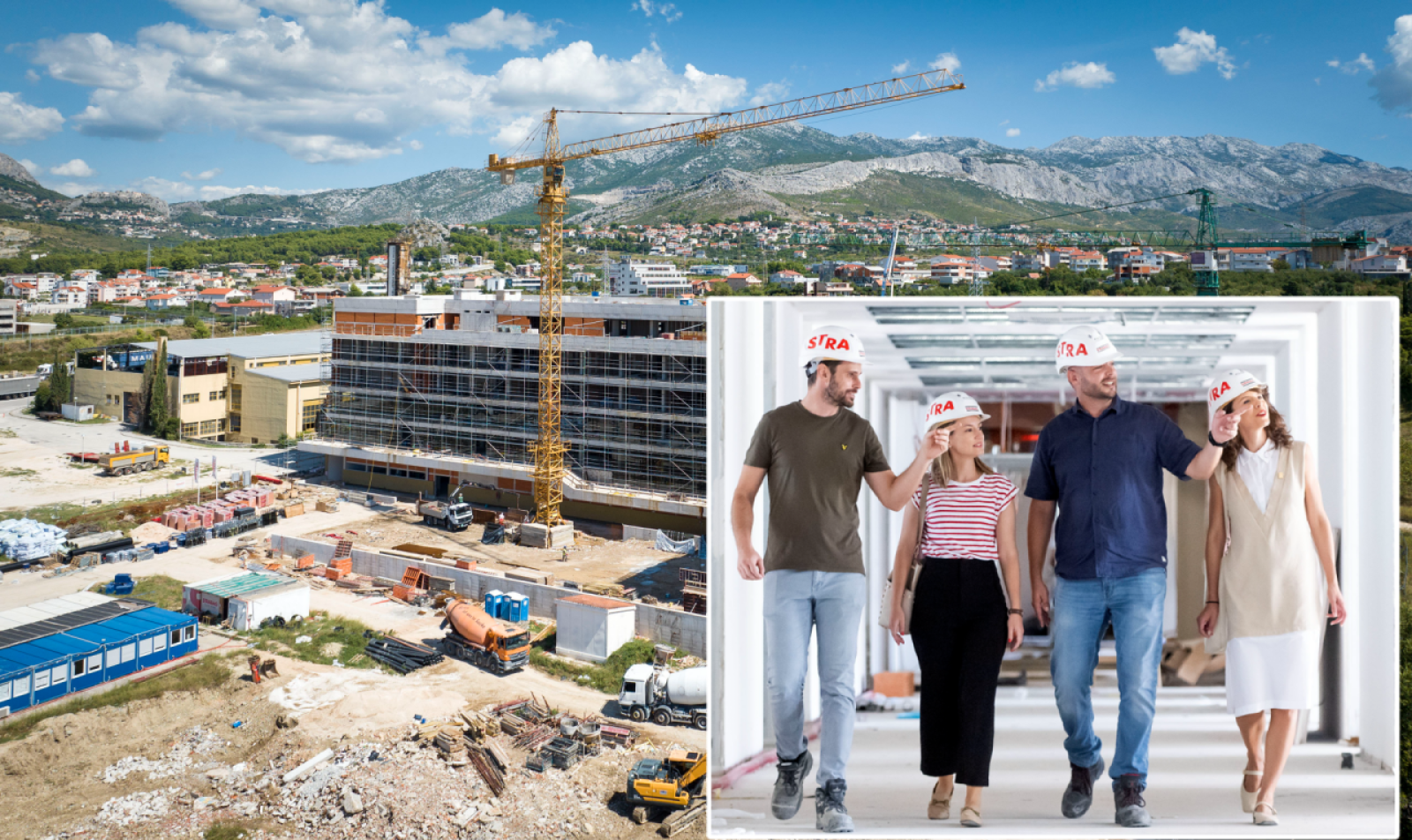
Far from the eyes of the Split public, on the outskirts that took their name from the thorny bushes (drače), the city’s brain is growing.
Indeed, being far from the debates and the endless complaints that greet every project has probably helped the first phase of the Technology Park – the project with which Split is catching up with the modern world of high technology – draw to a close quickly and successfully. To say we were surprised by the impressive project we visited right at the beginning of the end is an understatement – it was the first day of pouring the last roof slab, completing the reinforced concrete structure of the central and most important building of the Technology Park, which was first conceived in 2018.
Creative industries
As a reminder, the state donated part of the former barracks at Dračevac to Split, which produced the design and technical documentation, while the development agency RaST, which will manage the knowledge park in the future, prepared the applications for co-financing from European Union funds. The first phase of the project costs €22 million, of which €14 million comes from EU funds, and the central building, designed by architect Dario Gabrić, should be completed by the end of this year.
Built on an area of 17,500 square metres, it comprises office space for micro, small and medium-sized enterprises, a coworking centre, three high-tech laboratories, meeting rooms and a large congress centre, as well as ancillary facilities such as a canteen with a kitchen, a childcare area, and a fitness and recreation zone. It is estimated that it could accommodate a total of 1,950 people (a coincidental bit of symbolism?).
The central building has been erected west of the temporarily relocated Municipal Court, and two more buildings will spring up next to it in the future. The young team that has been working on this project for several years guides us around the construction site, which opened in spring 2022.
Andrea Racetin Muše, who manages this EU project on behalf of the City, takes us floor by floor – there are six of them – explaining the structure of the building that will house companies working in IT, the creative industries and other modern technologies.
– The basement is intended for coworking, that is, shared workspaces where several companies will operate, with a kitchen, meeting rooms, a fitness area and a childcare area. The ground floor houses the reception and a canteen with a kitchen. The first floor is home to the management and the incubators – fourteen offices with a small kitchen and a meeting room – and this floor also has a large conference hall with 400 seats, one medium-sized hall and two smaller halls that can be combined as needed.
The second floor is particularly interesting because interested companies will be able to move into the premises at the shell-and-core stage and fit them out to their own requirements, with units of around a hundred square metres each, followed by three high-tech offices with 3D printers and scanners. The third and fourth floors also contain office space, but on two levels, which users will fit out themselves, while the fourth floor also has a café and a kitchen – project manager Racetin Muše shows us, noting that the construction works will be followed by the interior fit-out, for which a public procurement procedure has already been carried out.
– The manager of the Technology Park, the Split Development Agency, is preparing a second call for expressions of interest, in which it will invite IT companies from our area and familiarise them with the terms of use of the premises in the Technology Park. As this is a project co-financed by EU funds, prices must be at market rates, while for the shell-and-core premises, which are likely to attract strong interest, the pricing terms will be adjusted so that we make the most of the capacity – she says, adding that Split is among the last cities in Croatia to build a centre of this kind, but it will be the largest, and its facilities, such as the conference halls, will in fact be available to all organisers of professional events, since the city lacks suitable public conference halls.
As we wander through the endless office space in the large building at Dračevac, we are in the hands of the engineers from Strabag, the contractor, whose works – under the constant supervision of European monitors – are proceeding very quickly by our standards.
– What is specific about this construction is, above all, the fact that designer Gabrić preserved around 70 per cent of the old barracks built in the 1980s, and we practically enlarged it by “pulling” a new building over it, with structural reinforcements. In this way we achieved maximum use of the existing building and reduced the amount of construction waste, which will be used in the next phases of construction – explains Veljko Grbeša, project manager and chief site engineer, noting that in addition to the usual construction works, the contractor was also responsible for producing the complete design documentation and obtaining the building permit.
Also with us is Domagoj Ćapin, site engineer, who is in charge of the interesting figures:
– We have 175 workers on site, most of them Turkish – they are exceptionally good builders – and there are local people too, of course. The central building will feature seven kilometres of brise-soleils, three thousand square metres of glass, seven lifts… And countless kilometres of cable. Our engineering team also includes Inela Salkanović, Toma Gotovac, Marijana Vrdoljak, Ivan Bošnjak, Mateo Babić, Mislav Franić, Toni Veber, Bernard Perutina, Ivica Livajić and Ana Vukšić – these people deserve a mention, we are really doing our very best to ensure the works are carried out to the highest standard and on time – says Domagoj.
A young team
Professional supervision is carried out by engineers from Trames, led by FIDIC Engineer Zoran Ivanković, while the project manager under the Building Act is Marijana Zvonar of Extructa. A major role was played by the staff of the City’s Public Procurement Section, headed by Katarina Nataša Dumančić Merćep – without proper procedure in public administration, there is no quality project.
Antonija Eremut Erceg, Head of the City of Split Development Service, has been involved in the Technology Park project from day one, ever since she headed the Development Agency.
– Altogether it took somewhat longer than we expected. True, we will complete the building just as the whistle blows on this financial perspective, but we will manage to use the EU funds available to us for this project, the largest financed through the ITI mechanism of the Split Urban Agglomeration. The team that worked on preparing and implementing the project, together with our external associates, gave it their all. Equally – and perhaps more importantly – we have learned a great deal for future projects. We had no financial corrections on the procurement of works, and reporting is going to plan; for colleagues working on EU funds, nothing more needs to be said – emphasises Eremut Erceg, adding that the project aims to create better conditions in the Split area for further strengthening the IT sector, all so that we can achieve a better balance of economic activity in the city, which ultimately affects education and the quality of life of all citizens.
– The exchange of ideas and cooperation are what add value to any business, and this is fully enabled by the technology park concept that ours will follow. We will also contribute to strengthening conference tourism until better conditions for that activity are created in the city. I see the construction of this building, and all the life that will emerge here, as a boost to the development of this hitherto neglected area. All developed cities work on regenerating exactly these kinds of sites, even though it is by no means an easy task, nor, at first glance, a particularly attractive one. These are processes that take years and decades, so we must give it our all and arm ourselves with patience and strategy – concludes Eremut Erceg.
FIRST USERS BY SUMMER
Goran Batinić, Director of Split Development Agency – RaST:
– We have been working on developing the central building of Split Technology Park for more than five years, so we are now nearing the end of establishing the physical infrastructure and at the start of forming a larger team and defining the way we will manage it. The RaST team is well known to people in Split’s IT sector, and we will soon be expanding so that we can take on the responsibility ahead of us in the best possible way. At the end of September or the beginning of October we will publish a non-binding call for expressions of interest for future users, and by next summer the central building will welcome its first users and host its first events.
TONI TRIVKOVIĆ: MODERN AND PROGRESSIVE
Split Tech City has been working for years to strengthen Split’s IT scene and promote our city as a Mediterranean tech hub. Achieving this takes more than goodwill and a quality programme from initiatives such as ours, just as the concrete walls of modern buildings built for the sake of form, in which nothing happens, are not enough. That is why we hope that the Dračevac Technology Park will combine modern infrastructure with progressive ideas and activities for the benefit of the entire IT sector and the wider community – says Toni Trivković, President of Split Tech City – Startup Association for the Promotion and Development of the IT Sector of Split and the Region.
Source: Slobodna Dalmacija / Jutarnji list (author: Damir Šarac)