AI agents, humanoids and quantum computing: what comes after generative AI?
AI that no longer just answers questions but carries out tasks on its own. Humanoid systems that need protecting from cyber attacks. Companies organised around intelligent agents. Quantum computing slowly making its way out of the lab. Tech Frontiers offers a look at technologies that are just now crossing the line between the future and real business.
Only a few years ago, generative AI looked like a technology of the future. Today it is part of the everyday work of a large number of companies.
That is why the frontier is shifting once again.
AI agents are gaining ever greater autonomy, artificial intelligence is entering industry and the energy sector, new security questions are emerging, and companies are no longer thinking only about how to add AI to their existing business, but about what an organisation built around AI from the outset would look like.
How is AI changing the companies we know today?
The programme opens with Nikola Kapraljević, CEO of Infinum, and his keynote Fight, Flight, or Evolve: Agencies in the AI Era.
If the same team can do considerably more work with the help of AI, what happens to the business model of a company that has for years been selling precisely human knowledge and time? How are teams, required skills, client expectations and the way value is created changing?
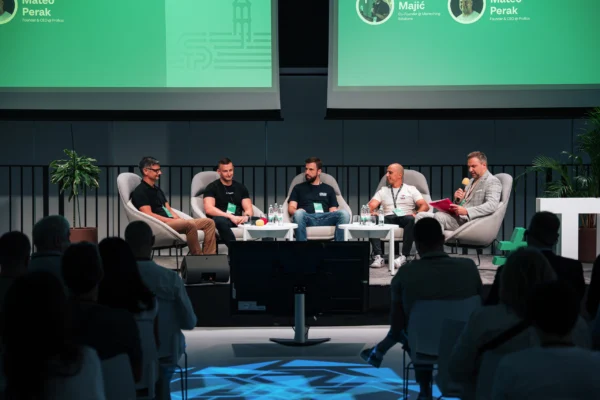
Next, Ivan Bešlić of Sofascore, Darko Jovišić of Robotiq.ai, Davor Aničić of Velebit AI and Sanja Cancar of paiper.one open up the next frontier – the transition from smarter products towards autonomous business.
But who will protect autonomous AI systems?
The more decisions we hand over to AI, the more important security becomes.
Ante Gojsalić, Senior Director of Engineering & AI Security at Zscaler, will speak about the security of AI agents and humanoids. When autonomous systems gain access to data, machines and physical space, a cyber attack no longer has to end with just a compromised password or database.
Tech Frontiers then moves from software to one of the largest real costs of any economy – energy.
Piet Jan Bloem, Managing Partner and founder of AIMZ, will speak about the application of artificial intelligence in energy efficiency.
Against the backdrop of the growing energy consumption of data centres, the electrification of transport and pressure on companies to reduce consumption, AI is often seen as part of the problem.
But it can also be part of the solution. Consumption forecasting, intelligent management of buildings and machines, production optimisation and the detection of unnecessary losses are areas where even a few percentage points of greater efficiency in large systems translate into enormous savings.
Tech Frontiers continues with AI in the future of work, digital transformation, data and the real-world implementation of AI systems.
Ivor Rothwell of IBM will raise the question of the AI-first company: how would you design an organisation today if you assumed from day one that part of the work would be done not by people, but by intelligent agents?
What is real, what is hype, and what comes next?
The programme concludes with quantum computing.
Luka Kaučić, IBM Quantum Ambassador and Qiskit Advocate, in his talk Quantum Computing: What’s real, what’s noise, what’s next, will discuss the real capabilities of a technology around which expectations in recent years have grown almost as large as those once surrounding artificial intelligence.
Tech Frontiers is not a stage about technology that may arrive one day. Much of it is already here. The real question is how ready we are for what comes next.
You can view the full programme on the conference website.