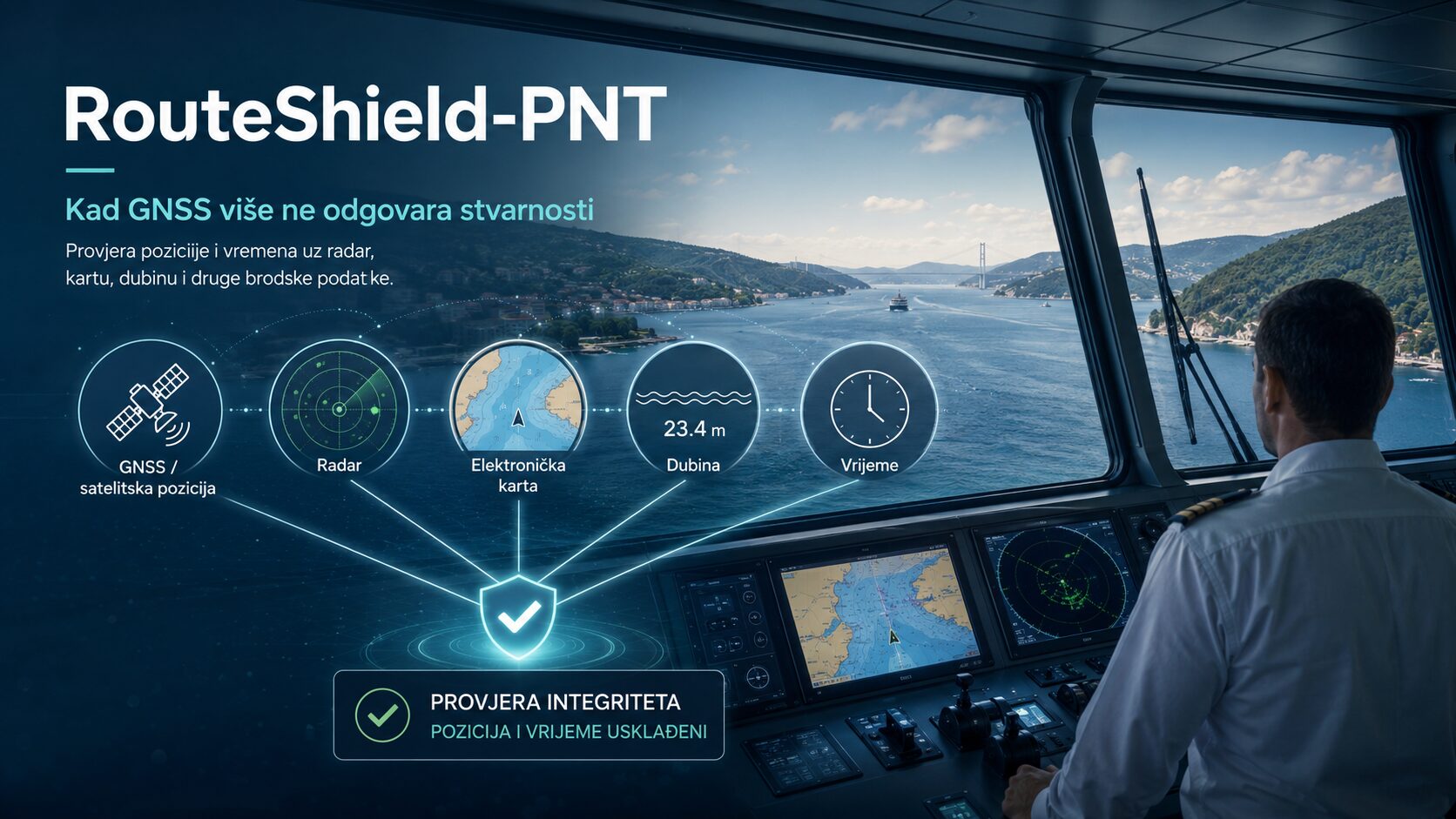
As of 1 June 2026, ELNAV.AI d.o.o. is a formal tenant of Split Technology Park. In the same period, the company is starting a new development phase of the RouteShield-PNT project, co-financed through DIGIT.2.2.01 – Seal of Excellence under the Synergies Program. This is a civilian research and development project in the field of maritime safety, focused on developing technology that helps the ship’s bridge recognise when GNSS position or time can no longer be trusted.
Most people refer to satellite navigation as GPS in everyday life. In the maritime sector, the broader term GNSS is more commonly used, covering several satellite navigation systems. On ships, this data is used to display position, plan routes, monitor movement and perform a range of other functions. Under normal conditions, the system works almost imperceptibly. The problem arises when the signal is jammed or spoofed, or when the ship receives data that looks plausible but no longer corresponds to its actual position.
This is exactly what RouteShield-PNT addresses. The system ELNAV.AI is developing will not rely on a single source of information. Instead, it will compare GNSS position and time against independent shipboard evidence: radar, the electronic navigational chart, an estimate of the ship’s motion, the echo sounder and an independent time reference. If these sources no longer agree, the system should alert the crew in a clear and standardised way.
In other words, if satellite navigation says “the ship is here”, but the radar, the chart, the depth and the ship’s movement show that this picture does not match, the bridge needs to know in time. RouteShield-PNT is conceived as an additional safety layer that helps the crew recognise risk earlier, reduce uncertainty and stay in control of decisions on the bridge.
It is important to stress that the system does not replace the officer, the master or existing navigation procedures. Its role is to help the crew spot inconsistencies more quickly that, in a complex situation, would be difficult to check manually fast enough. In the maritime sector, reaction time is often critical, especially in coastal navigation, port approaches, narrow passages and areas of heavy traffic.
Current events around the Strait of Hormuz clearly show the wider public why navigation resilience is no longer just a narrow technical issue. When important shipping routes come under the pressure of a security crisis, navigation no longer depends only on the ship, the crew and the weather. The reliability of navigation data, the security of communications, transit rules, insurance, risk to the crew and the ship’s ability to clearly understand its own situation all become important.
The RouteShield-PNT project previously underwent international evaluation under the Horizon Europe programme and was awarded the Seal of Excellence, the European quality label for projects that have passed the programme’s evaluation thresholds. Co-financing through DIGIT makes it possible to continue developing this kind of technology from Croatia – specifically from Split, a city with a strong maritime tradition and increasingly pronounced technological ambitions.
For ELNAV.AI, this is a continuation of a broader development direction: technologies for the ship’s bridge that help people before a risk turns into an incident. The company is already developing solutions focused on crew support and safety-critical decisions on the bridge, and RouteShield-PNT opens up a new area of specialisation in resilient PNT, i.e. resilient positioning, navigation and timing.
During project implementation, ELNAV.AI will work on engineering development, laboratory testing, preparation of a pilot system, validation in relevant maritime conditions, and dialogue with operators, marine equipment manufacturers and other maritime safety stakeholders. The expected result is a pilot-ready system that can be developed as a standalone device for existing ships or as a module that can in future be integrated into wider shipboard systems.
For Split Technology Park, the arrival of a project like this is yet another example of a high-tech product being developed within the local innovation environment. RouteShield-PNT brings together maritime experience, software development, safety engineering and Europe’s need for more resilient navigation systems. At a time when global trade and security increasingly meet at sea, projects like this show that relevant solutions can also be developed in Split.
For readers who want a deeper understanding of resilient positioning, navigation and timing, the ELNAV.AI white paper is also available: RouteShield-PNT white paper

The RouteShield-PNT project is co-financed by grants under DIGIT.2.2.01 – Seal of Excellence under the Synergies Program. The DIGIT Project is financed through Loan Agreement No. 9558-HR between the Republic of Croatia and the International Bank for Reconstruction and Development, part of the World Bank Group. The Ministry of Science, Education and Youth and the Croatian Science Foundation are involved in its implementation.